產品資訊
產品資訊
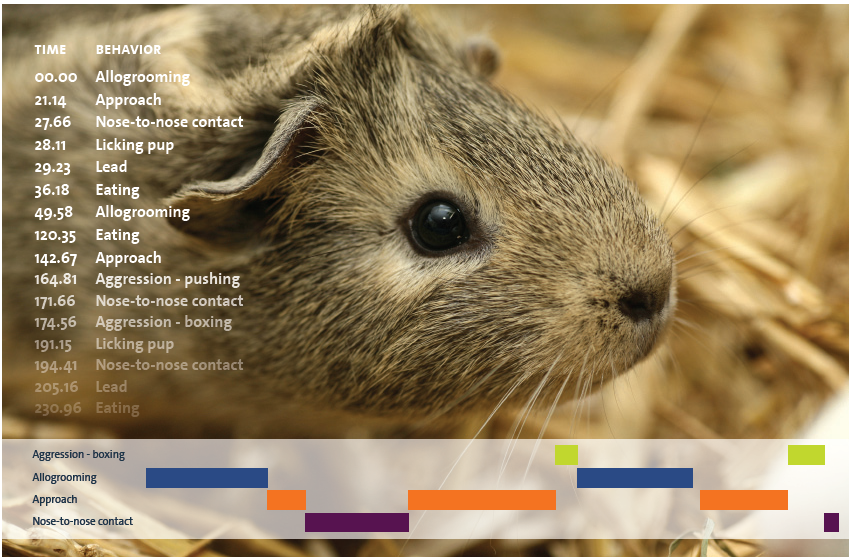
動物行為觀察軟體 Observer XT
產品型號:
廠牌名稱: Noldus
Noldus 行為觀察記錄分析系統是一個專業用於收集、分析和演示觀察資料且操作簡便的行為事件記錄軟體。
本系統支援研究專案的整個工作流程:系統設置- 資料收集- 資料分析
基本系統擴充:五大模組 – 可擕式行為觀察記錄分析系統 - 簡易編碼版


產品特點
Observing animal behavior can be done in a variety of ways, with automated tracking software or with behaviors noted by hand. In some research areas, a very detailed look at behavior is required. Self-grooming, play behavior, mother-infant interactions, feeding behavior, body postures, social hierarchy establishments, aggressive encounters: these are just a sampling of behaviors in which manual observation is best. The downside is that this can often be a laborious and even bias-prone process.
產品規格
掌上型行為觀察記錄分析系統
掌上型行為觀察記錄分析系統增加了研究的靈活性,並與行為觀察記錄分析系統完全相容 。
它把行為觀察記錄分析系統的優點和手提電腦便於攜帶的特點有機地結合在一起。
選擇最適合你研究的手持解決方案 :
- 掌上型電腦
- 智能手機
- 強大的手持設備
使用掌上型行為觀察記錄分析系統使得在自然環境下準確地編碼行為成為一件很容易的事情。其使用者介面是專門為即時編碼行為資料而開發的。甚至,你也可以在實際觀察中,將行為和修飾元素添加到掌上型行為觀察記錄分析系統的編碼方案中。
掌上型行為觀察記錄分析系統是暗中觀察和戶外使用的理想工具。即使在惡劣的環境下,如軍事野戰或重工業,你也可以信賴掌上型行為觀察記錄分析系統。
模組
行為觀察記錄分析系統的基礎模組為現場編碼和資料分析提供了解決方案。在此基礎上,該系統以5大模組功能滿足不同使用者需求。你可以選擇符合你研究需要的任何模組擴展您的系統。
1.高級分析模組
這個模組能使你執行兩個額外的分析類型:
1)可靠性分析 - 計算卡帕值:一致性和分歧的百分比,以及皮爾森相關係數
2)序貫分析 – 以記錄資料為基礎建立過渡矩陣。
2.視頻模組
視頻模組是記錄和重播兩個視頻源和創造視頻片段的理想工具。
3.多路視頻模組
多路視頻模組可以將管理的的媒體檔數擴展到四個。運用該模組的自訂版本,你還有可能擴展得更多。
4.外部資料模組
外部資料模組支援從多種資料獲取系統導入資料。它準確地同步從外部資料獲取系統中得到的同時發生的事件。你可以把觀察資料、視頻和生理信號結合在一起分析。行為觀察記錄分析系統10已經發展成為能夠對與觀察資料有關的多模式資料進行高級分析的系統軟體。這種獨特的功能將使行為觀察記錄分析系統10成為行為學研究中最完美的工具。
5 軟體開發套件(SDK)
軟體開發套件是用於連接定制軟體元件和資料介面的綜合檔包。它可以説明你開發自己的外掛程式和介面。一個軟體開發套件可供那些想要建立自己的模組或連接其他系統的開發人員使用。舉例來說,行為觀察記錄分析系統有一套機制,其功能是當行為觀察記錄分析系統使用者正在採取一些行動時執行其他(外部的)應用程式。這些行動之一是’開始觀察’。因此,你可以命令你所選的外部應用程式如一個照明開關,對這一行動作出反應。另一個例子是一個外掛程式程式,當你在行為觀察記錄分析系統中進行現場觀察時,這個外掛程式程式使得同時從外部程式獲取事件資料成為可能。外部事件,例如按下按鈕,都是和手動記錄的資料一起同時導入行為觀察記錄分析系統。如果你對我們的產品感興趣,請隨時聯繫我們的銷售部門以獲取更多資訊。
應用領域
Recent publications
- Wedl, M.; Bauer, B.; Gracey, D.; Grabmayer, C.; Spielauer, E.; Day, J.; Kotrschal, K. (2011). Factors influencing the temporal patterns of dyadic behaviours and interactions between domestic cats and their owners. Behavioural Processes, 86, 58-67.
- Breuer, M.E.; Chan, J.S.W.; Oosting, R.S.; Groenink, L.; Korte, S.M.; Campbell, U.; Schreiber, R.; Hanania, T.; Snoeren, E.M.S.; Waldinger, M.; Olivier, B. (2008). The triple monoaminergic reuptake inhibitor DOV 216, 303 had antidepressant effect in the rat olfactory bulbectomy model and lacks sexual side effects. European Neuropsychopharmacology, 18, 908-916.
- Butelman, E.R.; Prisinzano, T.E.; Deng, H.; Rus, S.; Kreek, M.J. (2009). Unconditioned behavioral effects of the powerful k-opioid hallucinogen salvinorin A in non-human primates: fast onset and entry into cerebrospinal fluid. The Journal of Pharmacology and Experimental Therapeutics, 328(2), 588-597.
- Campler, M.; Jöngren, M.; Jensen, P. (2009). Fearfulness in red junglefowl and domesticated White Leghorn chickens. Behavioural Processes, 81, 39-43.
- Cooperband, M.F.; Allan, S.A. (2009). Effects of different pyrethroids on landing behavior of female Aedes aegypti, Anopheles quadrimaculatus, and Culex quinquefasciatus mosquitos (Diptera: Culicidae). Journal of Medical Entomology, 46(2), 292-306.
- Hemsworth, P.M.; Barnett, J.L.; Karlen, G.M.; Fisher, A.D.; Butler, K.L.; Arnold, N.A. (2009). Effects of mulesing and alternative procedures to mulesing on the behaviour of physiology of lambs. Applied Animal Behaviour Science, 117, 20-27.
- Humle, T.; Snowdon, C.T.; Matsuzawa, T. (2009). Social Influences on ant-dipping acquisition in the wild chimpanzees (Pan troglodytes verus) of Bossou, Guinea, West Africa. Animal Cognition, 12, s37-s48.
- Lüttjohann, A.; Fabene, P.F.; Luijtelaar, G. van. (2009). A revised Racine’s scale for PTZ-induced seizures in rats. Physiology & Behavior, 98, 579-586.
- Pather, S.; Gerlai, R. (2009). Shuttle box learning in zebrafish (Danio rerio). Behavioural Brain Research, 196, 323-327.
- Ramseyer, A.; Boissy, A.; Dumont, B.; Thierry, B. (2009). Decision making in group departures of sheep is a continuous process. Animal Behavior, 78, 71-78.
- Razzoli, M.; Carboni, L.; Arban R. (2009). Alterations of behavioral and endocrinological reactivity induced by 3 brief social defeats in rats: Relevance to human psychopathology. Psychoneuroendocrinology, 34, 1405-1416.
- Schmied, C.; Waiblinger, S.; Scharl, T.; Leisch, F., Boivin, X. (2008). Stroking of different body regions by a human: Effects of behaviour and heart rate of dairy cows. Applied Animal Behaviour Science, 109, 25-38.
- Taylor, G.A.; Rodriguiz, R.M.; Greene, R.I.; Daniell. X.; Henry, S.C.; Crooks, K.R.; Kotloski, R.; Tessarollo, L.; Philips, L.E.; Wetsel, W.C. (2008). Behavioral characterization of P311 knockout mice. Genes, Brain and Behavior, 7, 786-795.
- Tereshchenko, Y.; Brandewiede, J.; Schachner, M.; Irintchev, A.; Morellini, F. (2008). Novelty-induced behavioral traits correlate with numbers of brainstem noradrenergic neurons and septal cholinergic neurons in C57BL/6J mice. Behavioural Brain Research, 191, 280-284.
- Trezza, V.; Schuren, L.J.M.J. van der (2009). Divergent Effects of Anandamide Transporter Inhibitors with Different Target Selectivity on Social Play Behavior in Adolescent Rats. The Journal of Pharmacology and Experimental Therapeutics, 328, 343-350.
- Venerosi, A.; Cutuli, D.; Colonnello, V.; Cardona, D.; Ricceri, L.; Calamandrei, G. (2008). Neonatal exposure to chlorpyrifos affects maternal responses and maternal aggression of female mice in adulthood. Neurotoxicology and Teratology, 30, 468-474.
- Vuckovic, M.G.; Wood, R.I.; Holschneider, D.P.; Abernathy, A.; Togasaki, D.M.; Smith, A.; Petzinger, G.M.; Jakowec, M.W. (2008). Memory, mood, dopamine, and serotonin in the 1-methyl-4-phenyl-1,2,3,6-tetrahydropyridine-lesioned mouse model of basal ganglia injury. Neurobiology of Disease, 32, 319-327.
- Yang, M.; Clarke, A.M.; Crawley, J.N. (2009). Postnatal lesion evidence against a primary role for the corpus callosum in mouse sociability. European Journal of Neuroscience, 29, 1663-1677.